Cell Division is a game about turning empty squares into connected territory. Two players place cells, cells grow into clusters, and whoever ends the game with more points wins. The rules fit in a paragraph. The depth comes from what you do with them.
Place a cell, score its connections
Players alternate placing one cell per turn on any empty square. Cells connect to same-color neighbors in all eight directions — horizontal, vertical, and both diagonals. Scoring is almost embarrassingly simple:
- 1 pointif the cell has no same-color neighbors
- +2 per axisfor each of the four axes with at least one same-color neighbor
- 8 pointsis the ceiling, when all four axes are lit
Those four axes — |, —, \,/ — are the whole engine of the game. Every decision you make comes down to which axes you're activating for yourself and which ones you're denying to your opponent.

Clusters are worth more than the sum of their cells
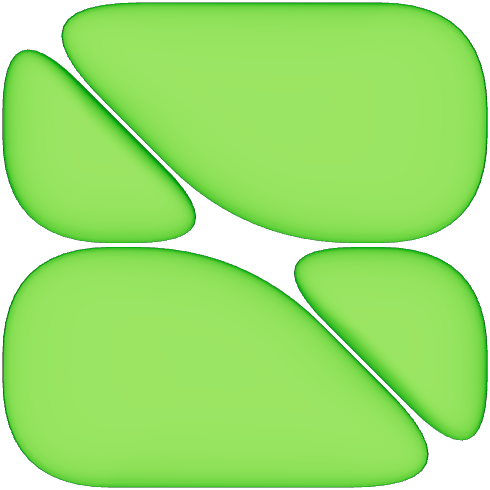
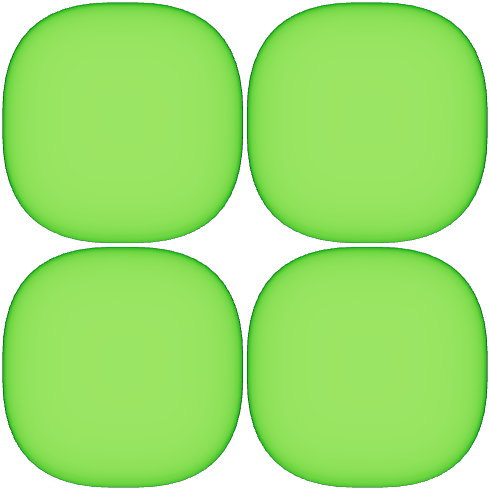
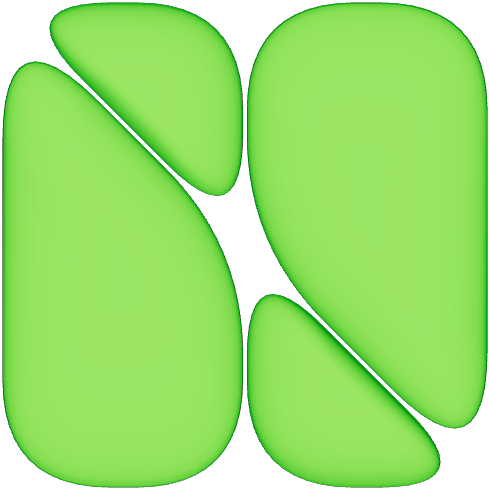
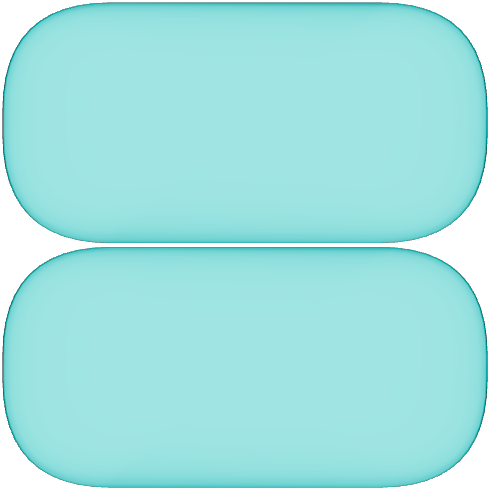
The lead gap balloons the moment you start building shapes instead of placing single cells. Say green takes the (0,2) hint and forms a 2×2 block. Every cell in that block now touches three neighbors along three distinct axes, so each one jumps from 4 points to 6.
(0,2), closing a 2×2 block. Every cell in the block now lights up three axes — green's total jumps from 12 to 24 with a single move.A single well-placed cell can double your score when it closes a shape. This is the whole strategic lever of Cell Division: look for the cell that fills an axis for multiple neighbors at once.
The game ends when the board is full
There are no captures, no timers, no resignations. When every square is occupied the game ends and the player with more points wins. That's it. Here's the same 3×3 board fully played out.


Four AI opponents, four different brains
The AI ships in four tiers, each with its own personality. They all run locally in JavaScript — no server, no WebAssembly, no GPU — and they all respond between taps.
- EasyPlays random moves. A calm on-ramp while you learn the rules.
- MediumPlays into open space and occasionally surprises you. Good place to start.
- HardAlways grabs the highest-scoring move. Reliable and predictable.
- EliteCNN distilled from an AlphaZero-style teacher. On the web it falls back to a 26-parameter switching linear network.
One more rule: the mirror forfeit
On a symmetric board, the second player could theoretically guarantee a draw by reflecting every move the first player makes. Cell Division detects five types of mirror strategies — vertical, horizontal, both diagonals, and 180° rotation — and if every second-player move mirrors the first, they forfeit immediately. It keeps the game honest.
That's the whole game. If you want to go deeper, the strategy post on claiming the interior covers why corners cap at 6 and how the 1-away pivot captures territory. And the AI post walks through the 14 features and training loop behind the Hard and Elite tiers.